


Rudy Loewe’s new mural in Brixton station is a nod to its loud, unapologetic history
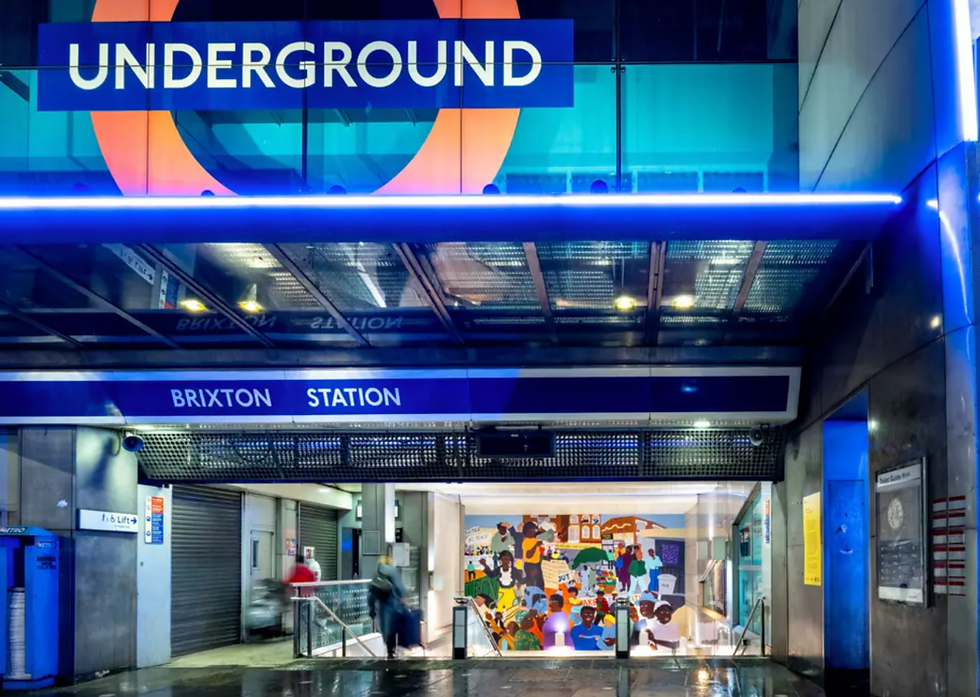
At the top of the stairs outside Brixton Underground station, you have the perfect perspective
to see its latest mural, 'The Congregation', and the bustling community it depicts. The TFL’s
Art on the Underground Brixton Mural programme’s newest installation by artist and
researcher, Rudy Loewe, is an ode to the area’s deep rooted historical idiosyncrasies. 'The
Congregation' holds up a mirror to Brixton, reflecting a history of protest, culture and
community.

As with any trip to Brixton, the first thing you’re hit with is a wave of sound. The high street is
usually packed with people. Stalls are set up outside the station featuring fruits and
vegetables on sale with aunties readily haggling for a fair price. People wandering in and out
of shops, heading to the market nearby, talking, laughing, singing. The people bring life to
Brixton and this is exactly what Loewe aimed to depict in their piece. “The first thing that I
wanted to do was to try to figure out how to create a sensorial experience through painting,”
they explained, “My experience of Brixton has always been that it's loud. You can just step
out your door for bread and the next thing you know, you're involved either in a discussion,
an argument or you're helping someone. That's almost inevitable in Brixton.”
After living in Brixton for a year themself, the aliveness of the area is an essence that
was imperative to capture for Loewe. Reminiscing on life in Brixton and aspects of the
community that they had wished to capture, they jokingly recall the street evangelists at the station as a staple, “I think I could do seven more of these paintings just on street preachers!”. The preachers embody a part of Brixton’s history to pay homage to. Their existence in the Lambeth archives, where Loewe spent time researching, points to their deeply embedded place in the fabric of Brixton’s ecosystem. This is true for many of the key figures present in the piece.

Preserving culture and history through archives is a central point of Loewe’s practice that is reflected in the details of 'The Congregation'. Notable features in the piece; Marcia Rigg (activist and sister to Sean Rigg who died in custody at Brixton Police Station), Yvonne Taylor and Eddie
Lockhart (founders of Sistermatic) and CJ Rivers (a TfL operator and representation of the
Windrush generation’s contribution to London’s transport) are each accompanied with
leaflets detailing their oral histories at the station. “I see myself as a storyteller, so finding ways to really honour those stories of people who have been doing incredible work, whose work may or may not be visible or known, I just feel honoured that people share their stories with me and allow me to include that in my work.”
Throughout the mural it is clear that the characteristic loudness of Brixton is also found in the
longstanding history of protest and activism in the area. A singular figure in the mural cries
out “no justice” as a crowd of people are unified in their collective response of “no peace”.
The facelessness of this crowd gives room for the murals viewers to insert themselves into
this cry for change. Loewe’s consideration of the action of gathering, who is “allowed” to
gather, in public spaces is reflected through this, particularly in a political climate where
protests are continually suppressed both locally and globally. Through Loewe’s work, it is presented as a central form of action in Brixton fighting against, as the mural shows, forced evictions and advocating for solidarity. While the erosion of community is a pressing topic that is prevalent in modern society, Loewe’s work here immortalises the unity of Brixton’s people.

From aunties to young children, Loewe set out to represent the vast range of Brixton and its people. Their hope is for Brixton residents to not only see themselves in the mural but to learn from it. “I hope that people can learn about different aspects of Brixton that they might not be so aware of,” they express, “I would love to see young people in Brixton, young artists in Brixton, be like, I actually feel inspired to make work about my local area because my local area is important”. Loewe’s mural is projected to be seen by around 30 million people in its one year tenure, many of which would be Brixton’s own residents.
For Loewe, this commission has been the fulfilment of a long term dream, “All of the
artworks that they've had there, Njideka Akunyili-Crosby, Denzil Forrester, Joy Lubinjo,
Claudette Johnson, it's an incredible lineage of artists to be a part of so I was really
honoured”. When the mural does eventually leave Brixton Underground Station, Loewe will
be left with their original piece and the memories of its communal impact. Most importantly,
Rudy Loewe’s 'The Congregation' has now become a part of the rich and restless history of
Brixton.
Written by Mayowa Amolegbe


Comments